Monday, January 29, 2018

Vintage 1950s Music


Music

          The number 3 hit on the Billboard Chart  in 1955 was Mitch Miller's version of The Yellow Rose of Texas. The song is a traditional American folk song. Members of the Western Writers of America chose it as one of the Top 100 Western songs of all time. Several versions of the song have been recorded, including those by Elvis Presley, and Willie Nelson.

          This song originally became popular among Confederate soldiers in the Texas Brigade during the American Civil War; upon taking command of the Army of Tennessee in July 1864, General John Bell Hood introduced it as a marching song.

          In September 1955, for six weeks, Mitch Miller had a Billboard number one hit with the song. Thirteen months later, Miller's version was used for a key scene in the 1956 Texas-based film Giant starring Elizabeth Taylor, Rock Hudson, and James Dean. The 1955 song became a gold record. The song achieved the #2 position in the UK and the #1 position in Australia.


Enjoy the memories! To listen to the song click on the link below. https://www.youtube.com/watch?v=VdATBTOotX4

Saturday, January 20, 2018

Vintage 1950s Men's wallets


1950s Men’s Wallets

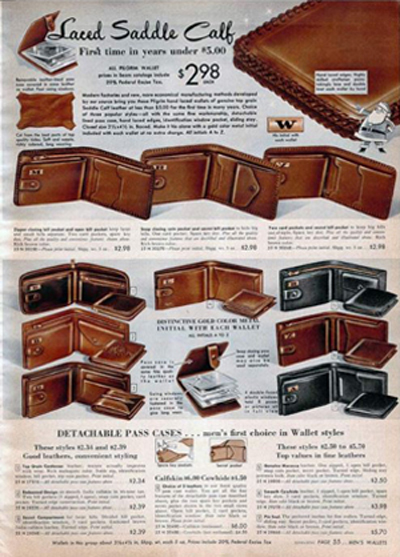
          Men’s wallets weren’t too much different than they are now. Brown or black cowhide leather was the smart choice. These wallets had several compartments for holding keys, ID cards, pictures, cash, and coins.
        Some wallets zipped around the edges to keep it closed and other had secret compartments. For that extra personal touch, men could get a wallet with his initials, his name or his favorite activity (like fishing) embossed on the front.

        Plastic inserts held pictures and other card-sized items. Some wallets even came in exotic leathers like sealskin, South African ostrich, alligator, water buffalo and almost any other kind of animal you can imagine.

        A fashionable man in the 1950s had a belt that matched his wallet.

Saturday, January 13, 2018

Vintage 1950s Scandals


Dotto 

TV Quiz Show

          Dotto, launched January 6. 1958,  was a game show that was a combination of a general knowledge quiz and the children's game connect the dots. Jack Narz served as the program's host, with Colgate-Palmolive as its presenting sponsor. Dotto rose to become the highest rated daytime program in television history, as of 1958. The show was abruptly canceled without public explanation over the weekend of August 16, 1958. The reason for the cancellation was revealed by CBS and NBC on August 18. the show had been fixed, tarnishing the show's reputation and setting the stage for legal and political investigation, of the fixing of 1950s quiz shows.

          Dotto's downfall began with a backstage discovery in May 1958. A notebook belonging to contestant Marie Winn was found by a standby contestant, Edward Hilgemeier Jr. The notebook included questions and answers to be used during Winn's appearances. He tore out the relevant pages of the notebook. Hilgemeier later reported that  Dotto's  producers paid him $1,500 to keep quiet about his discovery. Dotto on CBS, meanwhile, grew in popularity as 1958 went on and became the highest rated Daytime show on the air.

          Hilgemeier Jr. eventually decided to break his silence. He contacted the Colgate-Palmolive company on approximately August  8, 1958, with his story, which was then relayed to CBS. Executives at CBS and the show's sponsor quickly moved to confirm the allegation internally and worked the issue between August 11 and 16. CBS executive vice president Thomas Fisher tested kinescopes of the show against Winn's notebook and concluded that the show looked fixed. Executives at CBS series met with its creator, Frank Cooper, concerning the potential rigging of the show on the evening of Friday, August 15. Cooper admitted that the show was indeed fixed, and CBS then reported these findings to NBC as the hosts of the nighttime version. Over the weekend of August 16, both the CBS daytime and NBC primetime series were canceled. In the meantime, in an August 18 affidavit, Hilgemeier complained to the Federal Communications Commission that Dotto was fixed.


          Narz was not involved in the deception and cheating on "Dotto," and was immediately absolved of any responsibility when the story broke.

Sunday, January 7, 2018

vintage 1950s TV


Alfred Hitchcock Presents

          Alfred Hitchcock Presents is a television anthology series hosted and executive produced by Alfred Hitchcock, which aired on CBS and  NBC between 1955 and 1965. It featured dramas, thrillers, and mysteries. By the time it premiered on October 2, 1955, Hitchcock had been directing films for over thirty years.

          Alfred Hitchcock Presents is well known for its title sequence. The camera fades in on a simple line-drawing caricature of Hitchcock's rotund profile. As the program's theme music, Charles Gounod's Funeral March of a Marionette, plays, Hitchcock appears in silhouette from the right edge of the screen and then walks to center screen to eclipse the caricature. He then almost always says "Good evening."

          The caricature drawing, which Hitchcock created, and the use of Gounod's Funeral March of a Marionette as theme music have become indelibly associated with Hitchcock in popular culture.
          Hitchcock appears again after the title sequence, and introduces the story from a mostly empty studio or from the set of the current episode; his monologues were written especially for him by James B. Allardice. At least two versions of the opening were shot for every episode. A version intended for the American audience would often spoof a recent popular commercial or poke fun at the sponsor, leading into the commercial.

          Hitchcock closed the show in much the same way as it opened, but mainly to tie up loose ends rather than a joke. Frequently, in the filmed story, a leading character would have seemingly gotten away with a criminal activity; in the postscript, Hitchcock would briefly detail how fate (or the authorities) eventually brought the character to justice. Hitchcock told TV Guide[ that his reassurances that the criminal had been apprehended were "a necessary gesture to morality."

          Alfred Hitchcock Presents finished at #6 in the Nielsen ratings for the 1956–57 season, and at #12 in 1957–58, #24 in 1958–59 and #25 in 1959–60.  The last new episode aired on June 26, 1965, and the series continued to be popular in syndication for decades.

          Two episodes, both directed by Hitchcock himself, were nominated for Emmy Awards: "The Case of Mr. Pelham" (1955) with Tom Ewell, and "Lamb to the Slaughter" (1958) with Barbara Bel Geddes and Harold J. Stone.  "The Glass Eye" (1957) won an Emmy Award for director Robert Stevens. "An Unlocked Window" (1965) earned an Edgar Award for writer James Bridges in 1966.

          The most famous episodes remain writer Roald Dahl's "Man from the South" (1960) starring Steve McQueen and.  The episode was later referenced and remade in the film Four Rooms, with Quentin Tarantino directing a segment called "The Man from Hollywood."

Sunday, December 31, 2017

Vintage 1950s Women's High Heels


1950s Ladies high heels

          Stiletto Heeled Opera, court and pump shoes were all the rage in the early 1950s. At an extreme, they were very tall with 4-inch spiked ultra thin heels. Early on, the heels ended in a small metal cap that left dents in softwood floors, requiring some museum and courthouses to forbid stiletto shoes. The stiletto featured tall arches with a V-shaped cut away from the shoe sides.  Red was the boldest and most in-demand color for formal wear. They were impractical and mostly only worn for very special occasions, short durations, and by fashion models.

          The Winklepicker was an extreme version of the already extreme opera pump. With its sharp pointy toe and high thin heel, it was trendy in the late 1950s for formal and even semi-formal at home wear.
Thicker but still shapely tall heels continued to be worn with fancy dresses. Some heels had pretty all over designs carved, painted or printed onto them, while others had decorations around the edges.

          Strappy tall heel shoes were another ideal shoe for evening wear. Ultra-thin T-straps, slingbacks and ankle straps all provided just enough coverage to keep the shoe on but ultimately made the foot look bare.  Especially in nude colors and sometimes clear plastics, they complimented dreamy party dresses elegantly. 

          Kitten Heel Shoe After trying to balance on tall heels, most 1950s women regained their senses and accepted low but still thin kitten heel shoes. These classic dress shoes were safer to walk in yet still remained elegant and classy. Shoes were made of a soft leather or reptile skin. Suede and some fabric materials, like velvet or mesh, were used as well. Toes were very pointed in the early years and more rounded in the later years. For evening wear, jewel tone colors, especially glittery gold and dark silver, were fashionable.


          Baby Dolls. They featured very round toes that resembled a doll’s shoes. They came in many fun colors during the spring and summer, with cute accent decorations on the trim or an ornament on the vamp.


Sunday, December 24, 2017

Vintage 1950s New Years Parties

New Years, 1950s

          Ringing in the new year, in the 1950s, often included a midnight extravaganza at a hotel or company party. However, suburbanites soon realized that they didn't need to mingle with hundreds of people in order to have fun on New Year's Eve. A small party at home or open house with close friends and neighbors could be far more enjoyable than an evening spent jostled around by strangers and uninhibited pranksters. Twelve people were a good number, one for each month of the New Year. When old friends gathered, there was no need to plan entertainment, for time just seemed to whisk away, 'doin' what comes naturally, singing, dancing or just talking and reminiscing. And suddenly it was midnight, time for Auld Lang Syne, and supper. If you had 12 people and a large, round table one could set that table to resemble a huge clock, with one guest seated at each marked hour with two large paper hands indicating the hour.
New Years Eve
          New Year's Eve or Day Dinner was traditionally Roast Beef (your choice: rib roast, rolled roast, or pot roast), Horse-Radish Sauce, Potatoes,
Parker House Rolls, Lettuce with French Dressing, Orange Ice, Holiday Cookies or Fruitcake, Coffee

New Years Eve

          Then came the TV. Television has drastically changed New Year's Eve and Day for millions of Americans. Festive family dinners yielded to broadcasts and TV trays. Open houses replaced with TV's floats, flowers, and football. Sitting in their rocking chairs, TV viewers traveled from coast to coast and back again thru the magic of the one-eyed giant in the living room. So no longer did people have to entertain themselves, TV was the entertainment.
New Years Eve
            Often New Years Day had a very different menu for food and for television


New Years Day

          New Year's Eve and Day buffets became popular so guests could be by the TV. It included  Eggnog or Fruit Punch, Trays of Crackers, Bowls of Cheese Spread, Baked sliced Ham, sliced Roast Turkey, Buttered Slices of Rye, Whole Wheat, and White Breads, Olives, Celery, Radishes, Pickles, Potato Salad, Cranberry Jelly, Cookies, Coffee.
New Years Day

Then there was the cleanup!

Friday, December 15, 2017

Vintag4e 1950s Christmas Parties


Christmas Parties 1950s

          Holiday parties were held throughout the month of December. Parties included Company dinners and dancing, Club/organization awards dinners, church dinner and entertainment, neighborhood open houses and small gatherings. Again, people dressed for the occasion and they dressed well!


          A Christmas Open House was common in neighborhoods during the 1950s. A night out for couples in suburbia that was close in proximity was a blessing. Yet, dressing up was a must. So Open Houses were lavishly decorated and all the stops were pulled by the host and hostess.
          Common foods served for an Open House were buffet style and included:  Cheese balls, Broiled stuffed mushrooms, Deviled eggs, Broiled shrimp, Melon ball cocktails, Fruit cups and individual Jello molds with fruit and/or toppings.


          Traditional Christmas Eve Dinner was usually a buffet or sit down dinner. Either way, it was a wonderful way to connect with friends and family the night before Christmas. Typical 1950s menu was a glazed ham, parsley potatoes, spiced peaches, cornbread, vegetable scallops, Relishes Plates (Olives, pickles, celery), Eggnog pie, coffee and salted nuts and mints.

          Traditional Christmas Day dinner was usually, a more formal sit down dinner. The menu was cranberry juice cocktail, roast turkey with chestnut or sweet potato stuffing, giblet gravy, mashed potatoes, minted carrots, creamed onions or Brussels sprouts, fruit salad, Parker house rolls, Lady Baltimore Cake.

          Though the holidays were busy, turning down a lovely evening with friends, neighbors and co-workers were impossible in the 1950s.