Friday, May 18, 2018

vintage 1950s Scandals


The William Talman Scandal

          William Talman, a television and movie actor is best known for playing Los Angeles District Attorney Hamilton Burger in the long-running series, Perry Mason.

          In 1953, Talman played a sadistic, psychopathic killer in a film noir  The Hitch-Hiker. The New York Times wrote, "William Talman, as the ruthless murderer, makes the most of one of the year's juiciest assignments." His performance was also noted by Gail Patrick Jackson, executive producer of the CBS-TV series Perry Mason.

          What you may not know is his arrest. Sheriff's deputies raided a party on March 13, 1960, in a private home in Beverly Hills at which Talman was a guest. The deputies reported finding Talman and seven of the other defendants either nude or seminude. All were arrested for possession of marijuana an lewd vagrancy.  Municipal judge Adolph Alexander dropped the possession charge and dismissed the lewd vagrancy charges against Talman and the others on June 17 for lack of proof. "I don’t approve of their conduct," the judge ruled, "but it is not for you and me to approve but to enforce the statutes. Despite this Talman was fired by CBS.

          Talman was later rehired after Perry Mason producer Gail Patrick Jackson made a request to CBS following a massive letter-writing campaign by viewers.

                Talman was married three times and had 3 children and 2 stepchildren. He died of lung cancer on August 30, 1968, at the age of 53.

Friday, May 11, 2018

Vintage 1950s Food


Rice and Beef Porcupines

When I was young my mother made meatloaf every Monday. When she discovered this recipe the meatloaf retired and the porcupines were hired! I made some the other day, it serves about 4 people.

1 lb ground beef
2 tsp chopped onions
1/4 tsp poultry seasoning
1/2 cup raw rice, well washed
1/4 tsp pepper
1 tsp salt
3 tbsp fat
2 small cans of tomato sauce
1 cup of water

Form mixture into 10-12 balls, brown them lightly in a saucepan in fat
Drain off excess fat and add tomato sauce and 1 cup of water.

Cover tightly, simmer 45-50 minutes or until rice is tender. Serve with flavory pan gravy.

Thursday, May 3, 2018

Vintage 1950s Cars


Vintage 1950s
Dodge La Femme

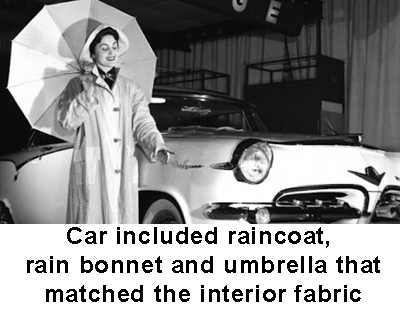
          The Dodge La Femme was a full-sized automobile produced by Dodge between 1955 and 1956. It was specifically designed for women.


          The La Femme's stemmed from Chrysler's all-male marketing department's observation that more and more women were taking an interest in automobiles during the 1950s and that women’s opinions on what color car to buy was becoming part of the decision making the process for couples buying an automobile. The La Femme was an attempt to gain a foothold in the women's automobile market.

          The  La Femme began as a 1955 Dodge Custom Royal Lancer " spring special" hardtop two-door coupe, painted "Sapphire White" and "Heather Rose". From there, the exterior received special gold-colored "La Femme" script that replaced the standard "Custom Royal Lancer" script on the car's front fenders.

          Upholstered in a pink rosebud tapestry with pale pink vinyl trim, the La Femme came with a keystone-shaped purse that could be stowed in a compartment in the back of the passenger seat. Each purse was stocked with a face-powder compact, lipstick case, cigarette case, comb, cigarette lighter and change purse, all made of faux-tortoiseshell plastic or pink calfskin and gold-tone metal, all were designed by “Evans”, a maker of women’s fine garments and accessories in Chicago at the time.

          For 1956, the La Femme returned, with no less fanfare; letters to dealers from Dodge’s marketing department called the La Femme a "stunning success". For 1956, Dodge replaced the Heather Rose and Sapphire White scheme with a Misty Orchid and Regal Orchid color scheme
          Dodge dropped the La Femme in 1957.  Production numbers, suggests fewer than 2,500 were made over the two-year period. At least 40 are known to exist of the 1955 version and approximately 20 for the 1956 version.

          Many theories exist concerning the low sales of the La Femme trim package. No evidence of magazine, television, radio, or other La Femme advertisements have been found since 1986. Given the large number of Dodge dealerships in the U.S. at the time, few of them received a demonstration La Femme for their showroom. Instead, single-sheet dealer pamphlets were the only clue that Dodge La Femme was available when other trim-special models such as the Chrysler 300 letter seriesPlymouth Fury, and DeSoto Adventurer were widely promoted.

Monday, April 16, 2018

Vintage 1950s men's ties


Vintage 1950s 
Neck Ties

          Neckties ties both narrowed and lengthened in the 1950s from the extremely wide and short tie of the 1940s. Designers also dumped the hand-painted novelty designs in favor of traditional stripes and textured solids. It made sense then that silk and shantung were perfect fabrics for men of this era.


          Some novelty themes did remain common- wine grapes, wine glasses, historical statues, graduated stripes, swirls, geometric art, modern art, and hobby motifs introduced some patterns to otherwise plain ties. Big patterns were part of the early ’50s and small hints of design made up the remainder of the 1950s.


          The 2-inch skinny knit/crochet tie was worn across college campuses both in solids and wide stripes.

Wednesday, April 11, 2018

Vintage 1950s Parties

AFTER-THEATRE PARTIES

          In the big cities, going to the theatre with friends for a night out was quite common. After-Theatre Parties became popular when more people began living in spacious homes or apartments. Restaurants in the city were usually booked after theatre performances, many decided, “Why not come over and have a party and a few refreshments?” Since everyone was already “dressed,” it was a great way to make the evening last longer.


          Many families moved to the suburbs in the 1950s. The husband took the train to and from work in the city. Wives often drove their husbands to the depot and picked them up in the evening. For an evening out, wives would take the train into the city and meet their husbands at the theatre. Hence dinner had to be postponed until after the performance. Couples who lived in the city would host the “after theatre” party. Slowly the suburbs began to build their own theatres and provide performances to satisfy the needs of the suburbanites for cultural events.


          A suggested buffet for that time was Welsh Rarebit, Stuffed celery, Olives, Chocolate Cupcakes and fresh fruit – or broiled Grapefruit halves and Coffee. Of course, there was always the ever-present, well-stocked bar.

Tuesday, March 27, 2018

1950s Vintage Ladies Fashions

1950s Ladies Handkerchiefs

          We're all familiar with the use of a dropped, laced handkerchief by women to attract the attention of young men, particularly in the late 18th century. Then the handkerchiefs were colorful, silk and embroidered.  They were also used to protect the ladies nose from terrible odors from the outside as they walked along the streets. Many women had lovely handkerchiefs they carried with them in public and plain cotton ones used at home for actual head colds.


          It was 1924, the birth of Kleenex introduced by Kimberly-Clark that caused the death of handkerchiefs.  Originally invented as a face towel to remove cold-cream, by the 1930’s Kleenex was praised as the antidote to germs with their slogan “Don’t carry a cold in your pocket.”   Many opted for a disposable alternative. In the mid-1950s a Little Golden Book featuring Little Lulu showcased things to make and do with Kleenex tissues, i.e.. showing children how to make bunny rabbits and more from tissues.  Its first printing sold 2.25 million copies.


          In the 1950s women's handkerchiefs were an accessory and came in many styles. Though a woman wouldn't leave home without a pretty handkerchief, it was rarely used except to dot perspiration or lipstick. Today, handkerchiefs are collected and admired but seldom carried or used.

Saturday, March 17, 2018

Vintage 1950s Toys


The Slinky

          In 1943, Richard James, a naval mechanical engineer stationed at the William Cramp and Sons shipyards in Philadelphia, was developing springs that could support and stabilize sensitive instruments aboard ships in rough seas. James accidentally knocked one of the springs from a shelf, and watched as the spring "stepped" in a series of arcs to a stack of books, to a tabletop, and to the floor, where it re-coiled itself and stood upright. James's wife, Betty, later recalled, "He came home and said, 'I think if I got the right property of steel and the right tension; I could make it walk.'" 

          James experimented with different types of steel wire over the next year and finally found a spring that would walk. Betty dubbed the toy Slinky (meaning "sleek and graceful").
          Richard James opened shop in Albany, New York, after developing a machine that could produce a Slinky within seconds. The toy was packaged in a black-lettered box, and advertising saturated America. James often appeared on television shows to promote Slinky. In 1952, the Slinky Dog debuted. Other Slinky toys introduced in the 1950s included the Slinky train Loco, the Slinky worm Suzie, and the Slinky Crazy Eyes.


          Over 300 million Slinkys have been sold between 1945 and 2005, and the original Slinky is still a bestseller.