Saturday, January 26, 2019

Vintage 1950s Chocolatiers-Russell Stover Candies, In

Vintage 1950s
Chocolatiers
A beautiful box of chocolates just says, Valentine's Day (among other celebrations.  I thought it would be fun to look up some of the popular chocolatiers of the 1950s. Enjoy your walk down memory lane.

Russell Stover Candies, Inc., founded by Russell and Clara Stover in 1923, is an American supplier of candy, chocolate, and confections. The corporate headquarters are in Kansas City, Missouri.
          Russell Stover Candies did not start with candy. In 1921, Russell Stover and his partner, Iowa schoolteacher Christian Kent Nelson, created the world's first chocolate-dipped ice cream bar. At a dinner party, Russell's wife Clara Stover suggested calling it an Eskimo Pie. The product was a success for them, making them quite a fortune in their first year.
          However, as other companies soon began to release similar chocolate-dipped ice cream products, Russell Stover was nearly forced out of business. The Stovers sold their share of the company for $25,000 and moved to Denver, Colorado. In 1923, Russell and Clara created the new company from their home, packaging and selling boxed chocolates. They were originally named "Mrs. Stover's Bungalow Candies". However, 20 years later, in 1943, it was renamed Russell Stover Candies.
          The company remained in the Stover family until 1969 when it was purchased by Louis Ward, who transformed the Midwest regional brand into a worldwide brand. The company expanded its chocolate brands by acquiring Whitman's in 1993  and Pangburn's in 1999. It was owned by the Ward family until July 14, 2014, when the Swiss chocolate maker Lindt bought Russell Stover Candies.

          So, taste buds ready for some chocolate now?


Saturday, January 19, 2019

Vintage 1950s Women's Fashion


Women's Fashion

Loafer/Moccasins

          The most casual shoe for girls and women was the loafer.  Moccasins fit into this category and were a staple in most young women’s closets. Easy to slip on, available in all sorts of fun colors, casual enough to wear with bobby socks or sockless, and durable enough to last all year, they were practically perfect.

          The penny loafer got its name by the slit in the decorative leather strap across the tongue. It was sized for a coin that teens would use to call home. Brown or white were the most common penny loafer colors. Other slip-on loafer shoes came in many colorful shades and shiny materials, like patent leather or plastic. Some were clear plastic, although they proved problematic once the foot started to sweat turning the plastic milky white. Yuck!

          Loafers were worn by women with sport attire, like play-suits, shorts, capri pants, and jumper dresses. Casual shoes for casual clothing was the rule. No stockings or even socks were required either.

Saturday, January 12, 2019

Vintage 1950s Men's Fashion


Vintage 1950s
Men's Fashion
Socks
          Socks that remained hidden under suit pants were the one area that had some personality in business dress. Argyle socks were very popular. Geometric designs on the ankles were also popular.


          Looking at men’s business sock choices today, we can see very little has changed since the 1950s. 

Saturday, January 5, 2019

Vintage 1950s Cars


Studebaker
          Studebaker (1852–1967)  was an American wagon and automobile manufacturer

based in South Bend, Indiana. Founded in 1852, the company was originally a producer of wagons for farmers, miners, and the military.
          Studebaker entered the automotive business in 1902 with electric vehicles and in 1904 with gasoline vehicles, all sold under the name Studebaker Automobile Company. After years of financial problems, in 1954 the company merged with luxury carmaker Packard to form Studebaker-Packard Corporation. However, Studebaker's financial problems were worse than the Packard executives thought. The Packard brand was phased out, and the company returned to the Studebaker Corporation name in 1962.

          After WWII, Studebaker was the only auto company to actually make a “new” 1950 model. Two series were debuted, the Champion with three trim levels and the pricier Commander which had a longer wheelbase.
only the Starlight Coupe had the drastic wraparound rear window.
          From the 1953 to 1955 Sports Coupe the new edition had a 275hp V-8 borrowed from Packard. It was race ready. Other Hawk models included Sky Hawk, Power Hawk and Flight Hawk


          The Hawk had air conditioning and 14″ wheels. The Lark was introduced as the nation slid into a recession. Demands for compact economy cars peaked. The Lark helped to increase Studebaker production by 150% and sales doubled. It came in two or four door sedans, a two-door hardtop and a station wagon model. But even this didn't save the company.

Saturday, December 15, 2018

Vintage 1950s Holiday Foods


1950s Holiday Recipes
Christmas Pudding
It's a long-standing tradition to add silver Christmas coins, charms or tokens to Christmas pudding. Why do people do this?
Well, whoever finds a Christmas coin in their slice of Christmas pudding is said to have good luck and wealth in the following year - and that can't be a bad thing.
However, only silver Christmas coins should be used rather than modern base metal currency. Also, you should never serve plum pudding with coins in it to small children or without alerting your guests to their presence.
Putting coins in your plum pudding is a really lovely way to add some fun and special memories to your Christmas day. If you exchange the silver coins for real money you'll get them back to use them for years to come, making a perfect family heirloom.

Easy Christmas Pudding
Ingredients
3 cups plain (all purpose) flour
2 teaspoons bicarbonate soda
2 teaspoon ground cloves
1½ cups dried mixed fruit
½ teaspoon salt
1 tablespoon butter, melted
2 teaspoons of your favorite holiday spice mix, or pumpkin pie mix
1 heaped cup sugar
2 cups cold tea (strained or from tea bags)
Directions
Mix all dry ingredients with two cups of cold tea and the melted butter.
For good luck and in keeping with an old Christmas tradition you can ask family members to each stir the pudding mixture and make a wish.
Once the ingredients are well mixed, pour them into a greased steamed pudding tin with a lid. Alternatively, use calico fabric and tie it with string and place the calico bag into a large heat-resistant bowl and cover with foil. The mixture can also be cooked as two smaller puddings if preferred.
Fill a large saucepan halfway with water. Place the pudding into the saucepan and put the saucepan onto the stovetop. Bring the water to the boil and then reduce it to a simmer to steam the Christmas pudding for 1½ hours.
Once the time is up, test the pudding with a metal skewer - if it comes out without pudding stuck to it, it’s ready to eat.
Serve your Christmas pudding:
We recommend you press your Christmas coins into the pudding at this point or after slicing up the pudding. Aside from avoiding scorching the silver during cooking, this method is best if you have young children as guests: for safety, their slices should not contain coins.
Serve slices of delicious hot pudding in bowls or on small plates. The Christmas pudding is best topped with dollops of brandy custard or brandy butter.
Serves 10-12 people. If there's any left it should keep in the fridge for around five days.


Saturday, December 8, 2018

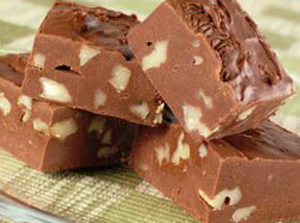
Vintage 1950s food- Mamie Eisenhower's Fudge

Mamie Eisenhower's Million-Dollar Fudge Recipe was a favorite holiday treat of the Eisenhower White House years and first appeared in Who Says We Can't Cook?, a spiral-bound collection of recipes published in 1955 by the Women's National Press Club of Washington, D.C. Mamie's husband Ike named the recipe.


Below is the original recipe if you would like to surprise yourself, parents or grandparents.

Mamie’s Million Dollar Fudge

Ingredients
4 1/2 cups sugar
pinch of salt
2 tablespoons butter
1 tall can evaporated milk
12 ounces semi-sweet chocolate bits
12 ounces German-sweet chocolate
1-pint marshmallow cream
2 cups nutmeats

Directions

Boil the sugar, salt, butter, evaporated milk together for six minutes.
Put chocolate bits and German chocolate, marshmallow cream and nutmeats in a bowl. Pour the boiling syrup over the ingredients. Beat until chocolate is all melted, then pour in pan. Let stand a few hours before cutting.
Remember it is better the second day. Store in tin box.


Monday, December 3, 2018

Vintage 1950s Food Sugar Cookies


1950s Holiday Recipes
Sugar Cookies

Cookie cutting and decorating reached its height during the boomer years with Christmas cookie cutouts of reindeer, trees, stars, and bells providing sustenance for kids and dads. During the holidays, Moms packed their favorite home-baked cookies into Tupperware containers and carried them to cookie swap parties with friends and neighbors. Red plastic cutters replaced tin cutters during the war years when metal was scarce. They can now be found today at garage sales and flea markets.


Easy Sugar Cookies
Ingredients

2 3/4 cups all-purpose flour
1 teaspoon baking soda
1/2 teaspoon baking powder
1 cup butter, softened
 1 1/2 cups white sugar
1 egg
1 teaspoon vanilla or almond or lemon extract

Directions

Preheat oven to 375 degrees. In a small bowl, stir together flour, baking soda, and baking powder. Set aside.
In a large bowl, cream together the butter and sugar until smooth. Beat in egg and extract. Gradually blend in the dry ingredients. Roll rounded teaspoonfuls of dough into balls, and place onto ungreased cookie sheets.
Bake 8 to 10 minutes in the preheated oven, or until golden.
Let stand on cookie sheet two minutes before removing to cool on wire racks.

Easy Cookie Frosting
Ingredients

4 cups confectioners' sugar
1/2 cup shortening
5 tablespoons milk
1 teaspoon vanilla extract
food coloring

Directions

In a large bowl, cream together the confectioners' sugar and shortening until smooth. Gradually mix in the milk and vanilla with an electric mixer until smooth and stiff, about 5 minutes. Color with food coloring if desired, and decorate your cookies.